Tuesday, October 8, 2024

Snippets from the Gardens of the British Embassy in Washington, DC

Fall is a lovely time to tour gardens.  The weather is cool, the leaves are beginning to change and everything seems to be slowing down before winter.

This week, I toured the gardens of the British Embassy in Washington, DC.  Originally designed by Sir Edwin Lutyens, the house and grounds are magnificent.
The gate in the courtyard to enter the gardens (notice the Heuchera 'Bridal Veil' that has been allowed to seed into the wall).
The front of the house and the rose garden.  The Gingko biloboa (male, of course) trees that flank the front entry were planted after Japanese Maples on decline were removed.  Pictures of Teddy Roosevelt on the front steps, with Gingko trees on the sides, guided the horticulturists to plant these new ones. 
Rather than simple limestone, Lutyens added slate pieces placed on edge, to add visual interest.  Set in sand or stone dust, these sections of the large hardscape are permeable and drain well.  
The view from the front entry across the lawn.  Before the Magnolias and other trees were so large, the view was of the Washington Monument.
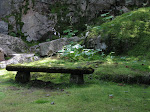
Over time, some of the slate has grown moss, giving it color and variation.
The head gardener prunes the Wisteria two times a week.
Steps to the perennial borders and upper lawn.  Even with nearly 10,000 for EU Day visiting the gardens, the Heuchera 'Purple Palace' survives in the crevices of the limestone steps.
Long into October, the perennial border is full of color and interest.


The walk to the kitchen garden.


The kitchen garden includes espaliered apples and pears with multiple varieties grafted onto the same stock, and Meyer lemons as large as a cantelope.
Inside the greenhouse, orchids are abundant.  Apparently, there are usually 40 blooming orchids inside the residence most of the time.
An orchid in bloom in the greenhouse.
Believe it or not, this is a cultivar of Trascendtia (Spiderwort) called 'White Velvet.'
I love peaking into other gardeners' potting sheds!


Thursday, May 23, 2013

No, Colored Mulch Is Not Pretty

Nicely landscaped garden bed with awful dyed mulch - perhaps to match the bricks?


Have you seen the commercial with the Irish man who has more time to spend with his wife because he uses dyed mulch?  I have never been so disgusted by a commercial, ever. 

Here is why.

Mulch is not a ground cover! 

Here is another reason why.

Mulch should absolutely break down over the year in order to add organic material back into the soil!

Garden beds are mulched for several important reasons:
  • To suppress weeds that might grow between plants.  A light mulching (1-2” deep) creates a nice barrier to help prevent weed seeds from germinating.
  • To help the soil retain moisture.  A light mulching allows rainwater to seep through and helps keep the soil from drying out too fast. 
  • To help the soil stay cool during the heat of summer.  Again, a light mulching helps keep the sun’s direct rays from penetrating and heating the soil and plants’ roots. 
  • To add organic matter back into the soil.  As the mulch is broken down, important microscopic organisms are working to do their jobs and enrich the soil.

Today’s residential and commercial landscapes are over-mulched.  Rather than planting, weeding, and maintaining a garden or landscape, garden beds are spread thickly with mulch, giving “green space” a nice brown coating, or in some cases, a wash of blood red wood shreds.  Where in nature would one find a blanket of red except on a field after a bloody battle?

Dyed mulches (black, red, dark brown (the actual color of shredded wood)) are often composed of recycled wood waste such as old hardwood pallets, decking, or worst of all, old pressure treated CCA lumber.  Ground up trash wood is treated with chemicals (for bonding) and dyes to give it a uniform color.

The biggest reason why I abhor dyed mulch is that it does not break down to enrich the soil as natural and organic soil does.  The possibilities of chemicals in the recycled wood trash that leach into the soil could harm, or even kill, beneficial soil bacteria, insects, earthworms, or even the plants the mulch is supposed to protect. 

When you mulch, you should use 100% and organic shredded hardwood, pine, pine straw or fines, or composted leaf mulch to do the jobs that mulch is supposed to do, and to make your garden full of beautiful plants (and not painted wood trash)!

Friday, May 17, 2013

The Cicadas Are Coming!

Cicada

Famously known as Brood II, the 17-year cicadas are due to begin emerging by the end of May.  To some, witnessing this natural phenomenon is awesome; to others, menacing and grotesque.

For me, it means calls from clients wondering what to do about their recently planted gardens.

Adrian Higgins, the Washington Post's garden writer, sums it all up nicely.  Not everything in your garden is at risk - in fact, unless your garden was planted in the past two years, you shouldn't worry at all. Established trees  and shrubs will recover.  Perennials and evergreens are not plants in which the cicadas like to lay their eggs.

So no worries, enjoy watching the beastly creatures and be grateful they won't return until 2030.

Friday, March 15, 2013

What are other gardeners reading?

I wonder what other gardeners and landscape designers are reading, not just for inspiration, but to gain historical perspective, or, perhaps to fall asleep?  I have shelves of books about gardens, many that I've read cover-to-cover more than once, others that no longer have a spine (not unlike my old Bible), and some very pretty ones that don't do much more than collect dust.


A few weeks from now, I'm thrilled to attend a book signing party for David Culp, and his new book The Layered Garden:  Design Lessons for Year-Round Beauty from Brandywine Cottage.  Of course, this is on my list of books to read and add to my collection - and one that will likely lose its spine.  I've heard David Culp speak about winter gardens and read articles he's written about plants and plant design.  His excitement for plants, particularly perennials, is contagious.  

Peeking into the book online, he includes a list of some of his favorite garden books . . . what a rare treat! I have quite a few on his list, but now have a few more to add to my library.

Thursday, March 14, 2013

Habemus flores!

Spring is almost here . . . holding my breath . . . and enjoying the early (and fragrant!) blooms of Hammamelis x intermedia 'Jelena' (Witch Hazel) and Sarcoccocoa hookeriana var. humilis (Sweetbox) in the garden.  


Thursday, March 8, 2012

Rare Finds


One of my favorite plant catalogs arrived in the mail today - Rare Find Nursery.  With gorgeous pictures and very detailed descriptions, it's like walking through a specialty nursery right from my desk.

As one of my winter projects, I have been reworking the front entry to our home, creating two new planting areas (and of course, giving me an excuse to re-plan the rest of the front garden).  Lucky me, I have part-sun, part-shade giving me many options for experimenting with some unusual perennials.  With gray fieldstone as a backdrop, I'm considering some plant colors I wouldn't normally combine such as the orange daylily Hemerocallis 'Barnegat Bittersweet Eyes' and Solidago sphacelata 'Golden Fleece.'  Adding something medium purple (the complementary color to orange) like Liatris pycnostachya and Allium spp. could prove to be quite stunning.
Hemerocallis 'Barnegat Bittersweet Eyes'

Solidago sphacelata 'Golden Fleece'
 
Liatris pycnostachya
Allium spp.

Wednesday, February 29, 2012

Spring Garden Tours in Washington, DC

Each spring, I take several garden tours, not just for ideas and inspiration for my work as a garden designer, but also to enjoy the labor and love that others put into their own gardens.  Last April, a friend passed along White House Garden Tour tickets (2012 dates are yet to be announced).  
View across the White House Lawn to the Washington Monument

Petals of Magnolia soulangeana spilling onto lawn by walk to the West Wing

A cherry tree hides the view of a bee hive (across from the kitchen garden)

The Kitchen Garden newly planted

Tulips and grape hyacinths

Spills

It seems that this is the year of retaining walls.  And my favorite part of designing walls, especially dry stacked fieldstone walls like this one, is the opportunity to show off plants that want to spill over them.  And not just the tried and true Phlox subulata, but also Deutzia gracilis, Geranium x 'Rozanne' and Campanula garganica 'Dicken's Gold' with its striking contrast of golden foliage and brilliant purple blue flowers.

Friday, February 24, 2012

Egotistical Gardening?

Is it too tacky to plant a cultivar that bears my name? Maybe, maybe not. But this bellflower, Campanula glomerata 'Caroline,'  might be perfectly suited to my perennial border that remains damp after a good rain. Offered by Plant Delights Nursery, this "rarely-seen, mauvy pink-flowered" perennial blooms in May and June and attracts hummingbirds. It grows best in moist soils and is heat tolerant.

I could have an entire "Caroline Garden" if I added Malus domestica 'Sweet Caroline' (apple tree), Clematis x 'Caroline' (flowering clematis vine), and Rhododendron 'Caroline Allbrook' (azalea), Rosa x 'Sweet Caroline' and Wisteria x 'Caroline.'   


Maybe Lenten Fridays Aren't So Bad . . .

 One of my "go to" sources when I'm in the mood for a taste of home - check it out - Homesick Texan.

Thursday, February 23, 2012

The Winter That Never Was

Now in the end of February, we haven't seen snow since October. The daffodils are blooming and the tulips are up out of the ground as though it is mid-April. I'm not complaining, but I haven't had my "slow months" to catch up, plan and write. As a landscape designer, I count on the cold nasty winter days to reflect and refresh before diving into the busy spring and summer seasons. Rather than completed, my winter projects - including my own garden changes - are still brewing in my mind.


Adding Vaccinum corymbosum, or Highbush Blueberry, to my own garden has been percolating in my brain these days, and not just to have a bushel of juicy berries to make a yummy crisp. This native plant also offers sweet flowers in spring and brilliant fall color. It can take a little shade in the garden, too.


But absolutely keep it away from the deer - they love the berries as much as I do!


Wednesday, December 21, 2011

Yeah, I've Got the Christmas Spirit

Tomorrow's To Do List:
  • Early morning meeting with client to review drainage plans
  • Attend Christmas Show at daughter's school 
  • Bake cookies for daughter's holiday party
  • Check client's garden installation progress, site new location for river birch tree
  • Pick up quick gift for "secret Santa" exchange at daughter's holiday party
  • Finish addressing, writing little personal notes, stuffing, licking, stamping and mail Christmas cards (picking up where I left off after the "F"s - only 135 to go!!)
  • Review gift list and pick up last few stocking stuffers
  • Send copies of client's patio plans to contractors for estimates
  • Find 5 sweet little hostess gifts to take to upcoming parties over next 3 days
  • Get gifts to husband's family to Federal Express (while 2-day is still an option!)
  • Hang wreath outside that has been lying on the ground for a week waiting until I attach the bow and buy some more floral wire
  • Buy more floral wire (at the hardware store - pick up a couple of stocking stuffers while there)
  • Plan Christmas eve and day menus
  • Prepare grocery lists for 2 different grocery stores
  • Finalize dog sitting schedule for post-Christmas trip to niece's wedding
  • Buy wedding gift for niece
  • Take husband's tux to cleaners
  • Write 3 thank you notes for holiday parties last week
  • Buy new slacks for son to wear to wedding
  • Shower and dress for 3 holiday parties
  • Drive children to various events for evening
Really, this is my list for tomorrow.  I don't get excited or worked up over Halloween because I know, every year, just around the winter solstice, I turn into the Tazmanian Devil.  

Monday, July 25, 2011

Roadkill

Being a good Texas girl, roadkill never frightens me. I've dutifully taught my kids the Roadkill Car Game (I one it, I two it, I three it, I four it, . . . I "eight" it.)

At a party recently, my friend - the host - asked, "what tree is this?" In the wee hours of the morning and after more than one glass of wine, that's not an easy question. I thought I knew, but in the dark, I couldn't see the bark or the form of the tree either. I surely didn't want to be wrong so I put off answering until the next day.  So I plucked a leaf to take home for researching in the morning.


My favorite horticulture professor warned her students of client roadkill questions and trained us by giving her infamous "roadkill quizzes." She would line up 10 small branches, sometimes with leaves, sometimes not, for us to identify. Her hardest was the cone roadkill quiz - yes, 10 cones from different conifers that we then had to identify the tree or shrub that produced the cone.

But she was right. I get these questions frequently, from friends, neighbors and clients.

The answer here:  Carya glabra, Pignut Hickory.

Thursday, April 28, 2011

Selecting Containers for the Garden

A new client is searching for the perfect containers for her front porch and back patio. The color of the container, as well as height and construction, must be consistent with the architecture of the house and reflect the taste and style of the client. 

Resin pots - small 8" square, medium 24" tall, large 30" tall


Cast concrete pots, stained brown - 24" tall and 30" tall
Glazed terra cotta pots 29" tall

Glazed terra cotta pots 30" tall


Glazed terra cotta with texture 30" tall

Small brown cast concrete 8" and 10" tall - to sit on small table
Stay posted for the final selection and finished product next week!


Tuesday, April 12, 2011

A Penny for Your . . . Tulips?

While I adore the artistic nature of creating an outdoor garden with all its color and texture, I am not so adept at crafting flower arrangements.  My stand-by is to buy lots and lots of the same flower and plop them in a big vase.  Lazy?  Perhaps.  Inexperienced?  Definitely so.  Like anything else, the more you research, learn and practice, the better you become.

I attended a flowering arranging program this morning presented by Washington, DC floral designer Phillipa Tarrant.  She shared three arrangements based on themes:  a Frank Lloyd Wright inspired window; a Chevy Chase Hunt Club arrangement completed with kiwi vines and pheasant feathers, and an incredibly simple, yet elegant bowl of purple tulips mimicking the look of a Tiffany glass window.


A Frank Lloyd Wright window
  Using a very low glass vase, the Oasis (foam material used in floral arrangements) was wrapped in Aspadidrus leaves, then stems of pussy willow were wrapped around the bottom the base for the tiny dots of texture as in the window.  Long stem roses, iris and billy-balls added the spots of color.  


Frank Lloyd Wright inspired arrangment

Philippa then, using a small 6" Oasis form that can be set inside of another container, such as hunt trophy (as was the idea here), she used greens and browns with spots of red to create a dramatic look that would spill over the edges.

Philippa demonstrates creating an arrangement to reflect a Chevy Chase Hunt Club scene
And lastly, and exquisitely simple, Philippa explained that just using a small bunch of tulips, left out for a short while so that the stems are more limp and easier to manipulate, an elegant arrangement can be made by just setting the bottom of the stems at the bottom of a large fishbowl (this one is 12" in diameter), and gently coaxing them to twist around the inside of the glass.  Here, only seven tulips are used.  For a bigger statement, use a grouping of three bowls sized 12", 8" and 6" to create a large arrangement on a small budget.

Philippa explains how tulips can be manipulated inside of a glass bowl

An "airy" arrangement of tulips
Of course, tulips always seem to fall limp after a few hours in a vase.  Philippa's trick - add a couple of copper pennies to the bottom of the vase and the tulips will perk right back up!  

Wednesday, March 9, 2011

A Chocolate Garden?

It's Ash Wednesday and I have, as I have since 1982, given up chocolate for Lent.  Easter is late on the calendar this year, and I was just thinking about how I might be able to fulfill my cravings without actually eating chocolate. 

What would be in a chocolate lover's garden?  Chocolate colored plants?

Dahlia 'Karma Choc'
A nursery in Washington state, Chocolate Flower Farm, specializes in all things chocolate for the garden, like the Dahlia 'Karma Choc' and Delphinium 'Kissed by Chocolate.'

Delphinium 'Kissed by Chocolate'
Chocolate scented orchids? Cocoa shell mulch?  There is no dearth of ideas about how to create a chocolate garden